Officials have rehearsed a 'reasonable worst-case scenario' for carbon dioxide disruption that could narrow product ranges in shops and affect hospitals and breweries
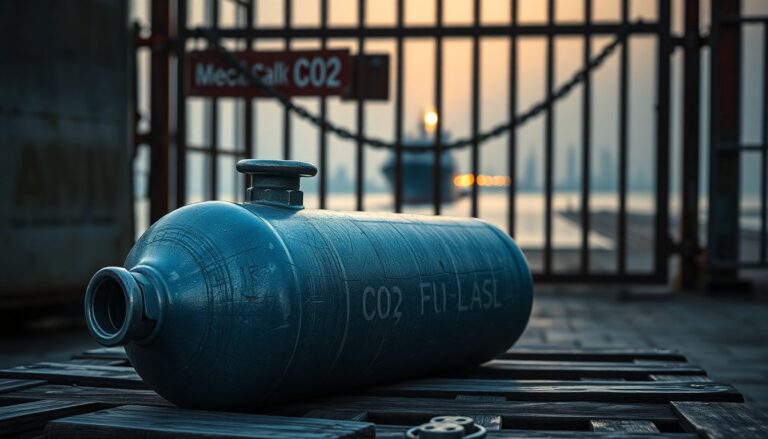
The UK government has quietly rehearsed contingency measures to cope with a potential shortage of carbon dioxide should the conflict involving Iran continue and the Strait of Hormuz remain closed. The exercise, run by the emergency committee Cobra and codenamed Exercise Turnstone, modelled a stacked set of problems: the shipping route staying shut, no peace deal, a mechanical failure at a key UK plant and a Europe-wide production decline because of high gas prices.
Those combined pressures were used to explore what ministers describe as a reasonable worst-case scenario, a planning concept designed to stress-test resilience rather than predict the future.
Details of the rehearsal show that teams across Number 10, the Treasury and the Ministry of Defence participated in mapping the risks and response options.
Planners used assumptions such as UK CO2 output falling dramatically — in one scenario to around 18 per cent of normal levels — because CO2 is typically produced as a by-product of ammonia and fertiliser manufacturing and can be vulnerable to both plant outages and reduced feedstock availability.
Officials emphasised that these exercises are precautionary, intended to identify practical levers to protect essential services and supply chains.
How a CO2 shortfall would affect food and drink
A drop in CO2 availability would primarily hit sectors that rely on the gas to preserve and prepare food. Packaging systems use modified atmospheres containing CO2 to slow bacterial growth and extend shelf life for salads, fresh meats and baked goods; abattoirs use it for the humane stunning of pigs and chickens. Breweries and soft-drink producers need CO2 for carbonation, which means that a squeeze could disrupt beverage supplies just as consumer demand spikes ahead of major events such as the football tournament starting on 11 June. Retailers could see reduced variety on shelves even if complete stockouts remain unlikely in planning estimates.
Impact on hospitality and farming
Restaurants, pubs and food processors would feel strain because many refrigeration and packaging systems depend on a steady flow of CO2. Farmers and meat processors have limited on-site reserves, so interruptions to supply can quickly translate into logistical bottlenecks for slaughter and distribution. Industry groups warn that even short-lived constraints can raise costs for producers; the Food and Drink Federation has signalled that manufacturers will try to shield consumers but that food inflation may still rise, with forecasts pointing toward notable increases in the second half of 2026.
Beyond the supermarket: medical and industrial uses
The effects would not be confined to grocery aisles. CO2 and its solid form dry ice are critical for medical logistics — cooling blood, vaccines and transplant organs — and for procedures and equipment including MRI scanning. Civil nuclear facilities and certain industrial processes also use CO2 for cooling and inerting. Because these are high-priority functions, contingency plans include measures to protect healthcare and national infrastructure in the event of constrained supplies.
Planned interventions and legal tools
Ministers have already taken steps to bolster domestic supply, notably by temporarily restarting the mothballed Ensus bioethanol plant on Teesside to produce CO2. Officials are also considering tactical options that would force a temporary reallocation of industrial capacity — asking factories to suspend other activity and run CO2 production at full tilt — and exploring emergency legislation to compel cooperation from firms if necessary. Officials have discussed the possibility of short-term relaxations to competition law so limited supplies can be prioritised for health and other critical services.
What households and businesses should expect
Government ministers and retail leaders say the public should not panic. The business secretary has reassured people that supplies are not currently a national emergency and that the government will be transparent if the situation changes. Major supermarkets, including Tesco, report no immediate problems and stress that their internal scenario planning and flexible sourcing should limit visible disruption. Nonetheless, consumers may notice fewer product choices in some categories this summer and should anticipate potential price pressures, even as authorities work with industry to prioritise vital uses of CO2.