A record-setting run in Beijing by an Honor humanoid has put robotic athletics in the spotlight and prompted questions about technology, entertainment and industrial strategy
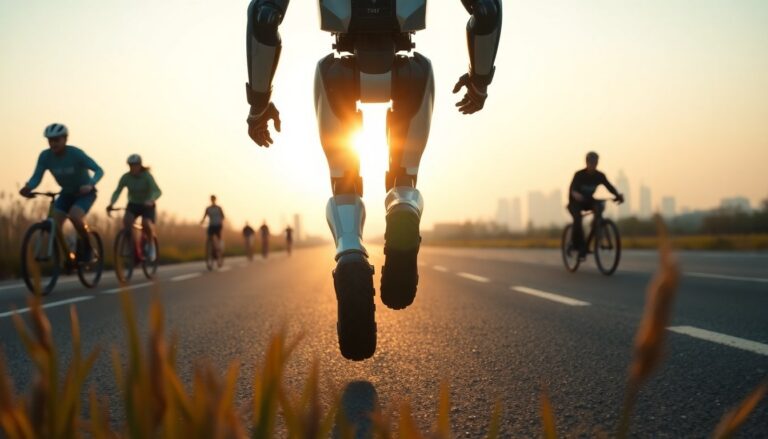
The outskirts of Beijing became the stage for an unexpected milestone when a humanoid runner developed by Honor completed the 21-kilometre course in 50 minutes and 26 seconds. The machine, known as Lightning, registered a time faster than the human mark set by Jacob Kiplimo, who recorded about 57 minutes and 20 seconds in a recent road race.
Organizers identified the event as the Beijing E-Town Half Marathon, where robots competed alongside human runners and generated widespread attention online. The performance was both a technical achievement and a public spectacle that revealed how quickly robot mobility is advancing on a global scale.
Not all moments were triumphant; footage circulating on social platforms also showed early mishaps, including a fall in which a robot’s limb casings detached on impact. Those scenes underscored the experimental nature of the field: progress is rapid, but durability and safety remain active challenges.
Beijing E-Town reported that about 40% of the entries navigated the course using autonomous navigation, while the remainder were remotely controlled. State outlets noted a remotely piloted Honor prototype crossed the line in 48 minutes and 19 seconds, but under the event’s scoring rules the autonomous Lightning was declared the champion.
How the run compares to previous robot efforts
This latest result represented a dramatic improvement over last year’s robot performance, when the winning machine required more than two hours and forty minutes to finish. That leap—from roughly 2 hours 40 minutes to under an hour—illustrates a steep learning curve in actuator design, thermal management and algorithmic gait control. Honor’s engineering team cited a long-legged architecture and an in-house liquid-cooling system as contributors to the result, technologies that the company says could migrate into industrial applications. The contrast between the 2026 and 2026 outcomes highlights how quickly teams iterate on balanced bipedal locomotion and energy systems.
Public reaction and the allure of robot sport
The spectacle prompted curiosity and mixed feelings among spectators and analysts. A 2026 YouGov poll found roughly one in three U.S. sports fans would be interested in leagues populated by robot athletes, with younger adults showing the most enthusiasm. Commentators describe much of the appeal as a blend of novelty and technical fascination: people are drawn to seeing machines perform tasks once the exclusive domain of elite humans. At the same time, critics point to comedy and fragility—robots tripping or colliding at events—as reminders that the shows are still early-stage experiments rather than polished competitions.
Industry dynamics: sport as a testing ground
Beyond entertainment, the half-marathon acted as a public showcase for an industrial arms race in embodied AI. Companies and research groups are using sporting contexts to stress-test sensors, actuators and control systems under crowd and environmental conditions. Major corporations such as Tesla, Hyundai and robotics firms like Unitree have invested heavily in humanoid platforms. Observers argue that sporting events compress the path from prototype to product by exposing hardware and software to repeatable, demanding scenarios that reveal failure modes faster than lab tests.
Competitions and long-term goals
Organized contests have long guided robotics research. The RoboCup, founded in 1997, set an audacious target: create a team of autonomous humanoid soccer players capable of beating the most recent FIFA World Cup champions by mid-century. Similarly, the World Humanoid Robot Games—launched in recent years—attracted universities and companies from dozens of countries and hosted events ranging from sprints to football-style matches. These tournaments are framed as both developmental platforms and public-facing demonstrations of progress, blending ambition with the occasional farcical incident.
Commercial and geopolitical stakes
Market assessments from industry analysts such as Omdia list Chinese firms like AGIBOT, Unitree Robotics and UBTech among the top vendors by shipment volume, with the first two reportedly exceeding several thousand units last year. Observers note an international competition for leadership in humanoid robotics that reflects broader technology and security priorities. Some experts argue the United States has advanced research and startups but has not yet organized large-scale, public professional leagues for humanoid competition on the same scale as recent events in China.
Looking ahead: possibilities and concerns
The Beijing run leaves open two broad paths. One is technocratic: sporting formats become a regularized method to accelerate engineering for healthcare, manufacturing or defense applications. The other is cultural and commercial: promoters build spectacles that attract viewers and investment, sometimes at the cost of glossing over safety or ethical questions. Thought leaders like Ed Warner, former chairman of UK Athletics, suggest human curiosity about contests beyond our species is nothing new, and that a segment of the public will likely embrace robot-versus-human matchups or robot-only leagues. Whether the future focuses on experimentation, entertainment, industrial spin-offs—or a mix of all three—remains a central question for designers, policymakers and audiences alike.