Inside a trial where robots, drones and uncrewed ground vehicles worked together to manage CBR hazards in confined urban spaces
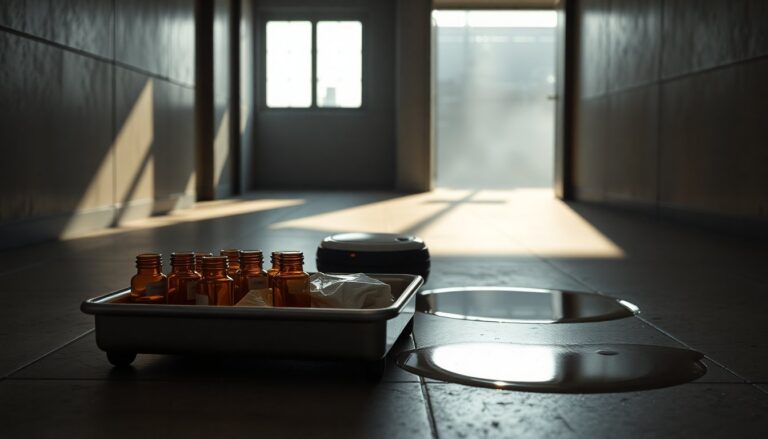
The threat posed by CBR substances is particularly acute inside enclosed structures where vapours and spills concentrate. In these settings, human responders face elevated risk, while unmanned systems allow operators to remain at a distance and manage the situation. In this article we describe how a government-backed exercise used a mix of remote and autonomous platforms to detect, sample and remediate contamination without requiring people to enter the hazardous area.
For clarity, CBR in this context is an acronym for chemical, biological and radiological threats, and the trial emphasised practical, deployable solutions rather than laboratory experiments.
The exercise took place in an unoccupied retail unit and was organised to move technologies from controlled research into a realistic, built environment.
The Defence Science and Technology Laboratory (Dstl) led the technical delivery, drawing on expertise in autonomy and operational analysis. Ian, Dstl’s technical lead, explained that the scenario helped narrow the gap between theory and field use by exposing machines and software to the messy realities of a public building.
The aim was to validate whether unmanned platforms could locate contaminants, take samples and carry out basic decontamination tasks in a way that would scale to real incidents.
Operational challenges of indoor CBR response
Confined urban interiors present a cluster of problems that are easy to underestimate. Low light levels make sensor work harder, cluttered layouts create navigation obstacles, and many surfaces sit out of reach for conventional platforms. Drones, while agile in open air, can struggle indoors with unpredictable airflow and tight corridors, especially when walls and fixtures share similar colours that confuse visual algorithms. The trial deliberately tested these weaknesses to learn where current systems excel and where further development is needed, focusing on resilience of perception systems and robust motion planning in low-visibility conditions.
Testing in a department store environment
To simulate a real incident, teams deployed machines through the empty retail space to sweep aisles, enter display areas and check service corridors. Autonomous and semi-autonomous platforms were tasked to detect residues, collect samples for later analysis and apply cleaning measures where practical. The scenario allowed operators to practise remote decision-making while monitoring a variety of sensors and sample streams. This built confidence that unmanned assets can perform the repetitive, hazardous tasks that would otherwise expose human teams to dangerous substances.
Environmental navigation and adaptability
The trial also evaluated how machines cope when control must shift between autonomy and human oversight. Several vehicles operated primarily under autonomous plans but could be switched to remote control for delicate tasks. The exercise revealed the importance of flexible control modes and tool use: platforms that could climb stairs, manipulate doors or manage handheld implements significantly broadened operational options. Those capabilities helped demonstrate how a heterogeneous fleet can cover more of an incident’s demands than a single type of vehicle alone.
Specialist systems and the partnership behind them
A range of academic and industry partners contributed specialist hardware and software during the Defra-funded exercise. A multi-directional drone fitted with a swabbing rig was used to sample surfaces and deliver a targeted decontamination spray. Createc supplied advanced robot control software that coordinated a mixed fleet including a small drone, a quadruped robot (a “robot dog”) and several four-wheeled vehicles, enabling data fusion and task allocation across platforms. The University of Bristol demonstrated an uncrewed ground vehicle with a robotic arm designed to work alongside a tethered drone so that spray-based decontamination could reach a variety of heights and angles.
These trials are supported by the Department for Environment, Food and Rural Affairs (Defra), which funds work to improve national recovery capabilities. Ewen, Defra’s recovery science lead, noted that field exercises like this provide better value for the public purse because they reveal practical constraints and unexpected opportunities that laboratory work often misses. To bring coherence to future efforts, Defra and Dstl have created the National Technical Advisory Group for CBR Recovery (NTAG-R), which will advise on the capabilities, requirements and technical standards needed to conduct safe and effective CBR recovery operations across the UK.