

Haiti is experiencing a surge in violence and political instability following the dissolution of the Transitional Council, which has now transferred leadership to Prime Minister Fils-Aime.
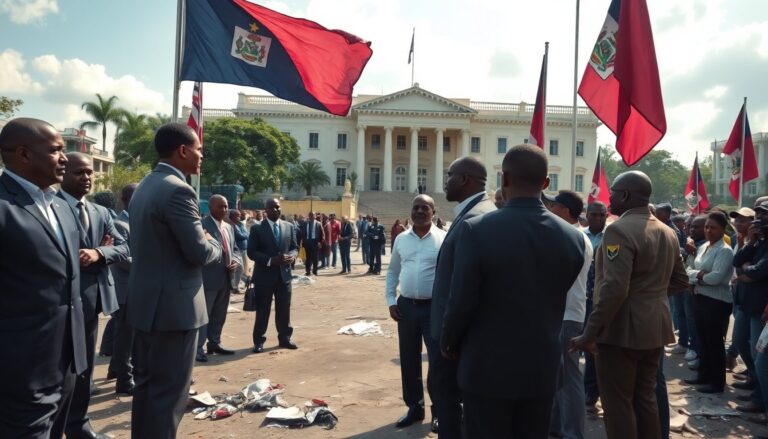
Haiti’s transitional presidential council hands power to prime minister
In a notable political development, Haiti’s Transitional Presidential Council has transferred authority to Prime Minister Alix Didier Fils-Aime. This decision follows nearly two years of governance characterized by escalating gang violence and widespread instability, which have severely impacted the nation.
The transition of power, carried out under stringent security measures, underscores the deteriorating conditions within the country and highlights the influence of external powers, particularly the United States.
Context of the transition
The current power handover occurs against a backdrop of significant political turmoil in Haiti.
The government faces ongoing challenges as criminal activity escalates. Gangs have seized control of approximately 90% of Port-au-Prince, the capital, resulting in thousands of fatalities and displacing over a million residents. The UN has reported alarming figures, revealing that nearly 6,000 individuals lost their lives in the past year due to gang-related violence.
The role of the Transitional Council
Established in 2026, the Transitional Council aimed to stabilize Haiti following the assassination of President Jovenel Moise. However, internal conflicts and allegations of corruption quickly undermined its effectiveness. The Council’s attempts to manage the political crisis faltered, leading to plans to remove Prime Minister Fils-Aime. This prompted a swift response from the United States, which imposed visa restrictions on Council members accused of corruption.
The current situation
Prime Minister Fils-Aime now faces the daunting task of navigating a nation plagued by violence and political gridlock. Despite the official announcement of the Council’s dissolution during a ceremony, the path ahead remains fraught with challenges. The absence of an elected government for over three years has created a vacuum that gangs are eager to exploit. The UN has reported alarming figures, revealing that nearly 6,000 individuals lost their lives in the past year due to gang-related violence.
Impact of gang violence
Haiti’s political crisis has enabled gangs to transform from local criminal entities into formidable coalitions, controlling extensive areas of the country. These groups impose their own rules, taking advantage of the lack of state authority to govern through violence and intimidation. This criminal governance not only disrupts daily life but also hampers efforts to restore order and facilitate humanitarian aid.
Additionally, the rising violence has compelled the international community to take action. The United Nations has authorized an international security force, but the deployment of this initiative has been sluggish, with fewer than 1,000 troops currently on the ground. The objective is to strengthen Haiti’s police forces, which have struggled to maintain control as gangs persist in exerting their influence.
Challenges ahead
As Prime Minister Fils-Aime resumes his leadership role, he faces the daunting task of organizing Haiti’s first general elections in a decade. However, the current political instability raises doubts about the feasibility of timely elections. Previous attempts to schedule elections have been delayed, leading many to question whether the transitional government can establish a credible framework for democratic governance this year.
The implications of Haiti’s political crisis extend beyond its borders. The United States regards the Caribbean as a strategic region, with a focus on managing migration and security challenges. As instability escalates in Haiti, the likelihood of mass migration increases, prompting neighboring countries to further tighten their border controls. This situation creates a complex array of challenges for both local and international policymakers.
The international response
In response to escalating violence in Haiti, the international community has imposed sanctions targeting gang leaders and their financial backers. The United States, along with other nations, has advocated for a unified strategy to restore order. However, the effectiveness of these measures remains uncertain, as the cycle of violence continues unabated.
Although some progress has been made regarding international support, establishing a robust and accountable governance structure in Haiti is increasingly critical. Without addressing the root causes of instability and gang control, the nation risks descending further into chaos.
Fils-Aime’s leadership will be evaluated not only on his ability to address the ongoing crisis but also on his effectiveness in establishing a stable and democratic Haiti. The challenges ahead are significant, yet they are essential for the nation’s future and the well-being of its citizens.
