

Thai officers concealed themselves inside a red-and-gold lion costume during Lunar New Year celebrations to approach and detain a 33-year-old man suspected of repeated burglaries, after investigations traced stolen amulets he had sold
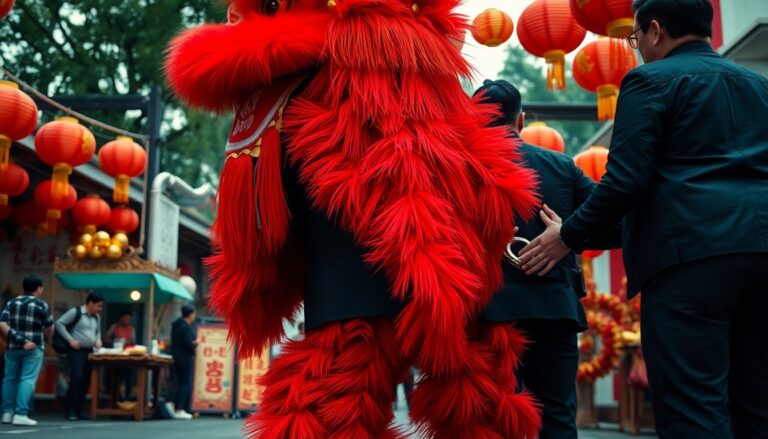
The Bangkok police devised an unusual tactic to apprehend a thief who had repeatedly evaded capture: they blended into a cultural celebration by taking the role of lion dancers. The operation took place at a temple fair in Nonthaburi, a province bordering Bangkok, where Lunar New Year activities draw crowds and traditional performances.
Officers entered the festivities wearing a red-and-gold lion costume, relying on the common presence of such dances to move close to the suspect without arousing suspicion.
Video released by the police shows the disguised officers advancing in the midst of the crowd, the officer operating the lion’s head suddenly lunging and subduing the target.
The man, aged 33, was accused of breaking into the home of a local police commander on three separate occasions earlier this month and stealing valuables estimated at about two million baht (roughly £47,540). Authorities say earlier arrest attempts failed because the suspect was vigilant and quickly fled when he spotted officers.
How the operation was planned
Investigators pieced together the suspect’s pattern by following items he had sold after the thefts. In particular, they tracked stolen amulets that had been put on the market, which helped place the man at specific locations. Detectives also noted that he frequented temples in Nonthaburi, so they chose a temple fair where lion dances were scheduled as an ideal environment for an undercover operation. By using a familiar festival performance as cover, officers could circulate among worshippers and visitors without attracting attention.
Selection of cover and risk management
Choosing the lion dance as a disguise was tactical: such dances are a routine part of Lunar New Year events and allow for a two-person costume team to move closely together while drawing little scrutiny. The officers rehearsed the approach and timed the arrest to coincide with the performance’s movement pattern. Police emphasized operational discretion, noting that many earlier attempts to detain the suspect failed because he quickly identified uniformed personnel. The festival setting reduced the risk of alarming the suspect prematurely.
The arrest and immediate findings
The moment captured on video shows the lion dance closing in on the suspect, followed by a rapid intervention when the officer in the head of the costume sprang forward and pinned the man to the ground. Police later stated that the suspect confessed to the burglaries, telling investigators he had stolen to fund drug use and gambling. Records released by the authorities indicate the man had prior convictions related to drug offences and burglary, adding context to his criminal history and the motives he provided during questioning.
Evidence and charges
According to police statements, the recovered evidence included items linked to the commander’s residence and the amulets traced during the investigation. Those items, together with the confession, form the basis for the charges the suspect faces. Authorities also highlighted the importance of tracing the sale of stolen goods—in this case, religious amulets—as a practical investigative avenue that led them to narrow down the suspect’s location and habits.
Cultural setting and public reaction
The operation depended on the local prevalence of Lunar New Year festivities. While the Lunar New Year is not an official national holiday in Thailand, communities often host celebrations where lion dances are a visible element. Using that cultural context allowed officers to act in a way that appeared ordinary to bystanders. Public responses to the tactic have been mixed, with some praising the creativity and effectiveness of the arrest, and others raising questions about safety and the use of cultural performances in police work.
Police defended their approach as a measured response to a suspect who had repeatedly avoided arrest and was linked to significant thefts. They described the operation as targeted and conducted with attention to minimizing disruption at a busy temple fair. The case underlines how investigators sometimes leverage local customs and environments to close gaps in surveillance, and it demonstrates the role that community events can play—both as investigative opportunities and as settings requiring sensitive, well-planned police activity.
Going forward, authorities say they will continue to develop investigative leads based on recovered items and witness statements from the festival, while balancing respect for cultural practices. The arrest at the temple in Nonthaburi offers an example of law enforcement adapting tactics to fit a specific context, using local tradition as a camouflage to bring a repeat offender into custody.
