Tiger Shroff escaped unharmed while his driver was wounded; investigators uncovered a week‑long reconnaissance and arrested the three gunmen the next day.
On the evening of 18 October, a convoy bearing Bollywood actor Tiger Shroff was ambushed near a Juhu football field. Five bullets struck the vehicle, leaving the star unscathed but wounding his driver, Firdous Ibrahim Baloch, in the left wrist.
The actor immediately drove the damaged car to the nearest police post before being escorted to Nanavati Hospital for the driver’s treatment. The incident instantly sparked a city-wide investigation, prompting Mumbai’s Crime Branch to launch a multi-pronged forensic sweep of the surrounding area.
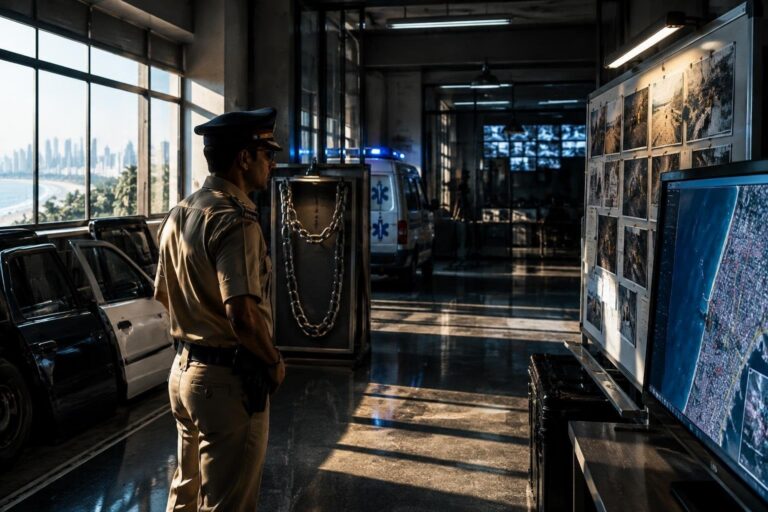
Detectives quickly secured the CCTV feeds from the vicinity of Shroff’s residence and the sports ground. The visual data revealed a pattern of repeated foot traffic by three unidentified men in the days leading up to the attack. By cross-referencing the footage with mobile-tower logs, investigators reconstructed a timeline that began a full week before the shooting, exposing a calculated scheme rather than a spontaneous act of violence.
Surveillance and planning before the attack
Police determined that the three suspects performed at least two reconnaissance runs on 11 October, positioning themselves near the Pushpa Narsee football ground where Shroff routinely practices between 5 p.m. and 7 p.m. on Sundays. The actors lingered by the gate, peering inside the adjacent residential complex to verify the star’s presence. Recce a term used by law-enforcement for pre-operational scouting, was evident in the footage: the men moved methodically, noting entry points and vehicle parking spots. When Shroff missed the match on that specific Sunday, the perpetrators withdrew, only to return on 18 October, armed and prepared.
Further analysis of social-media uploads by paparazzi and local bloggers indicated that the trio had built a visual dossier of the star’s habits. Screenshots of his Instagram posts, combined with satellite imagery of the neighborhood, allowed the gunmen to map daily routes and predict the exact moment Shroff would exit his vehicle. By 4:30 p.m. on the day of the attack, the suspects were observed walking toward the gate, checking whether the star’s car was present before finally opening fire at approximately 7 p.m.
How the assailants were identified and captured
The three individuals—identified as Ritik (alias Roshan) from Begusarai, Rehan (alias Sukka) from Sonipat, and Phool Singh from Kota—were quickly linked to the crime through a combination of CCTV, call-data records and a distinctive yellow 220 cc motorcycle. The bike, later recovered abandoned near Andheri West railway station, had been purchased illegally by the suspect known as Hrithik Roshan alias Kumar for a modest sum of ₹25,000, without a proper transfer of ownership. Interrogations of the bike’s former owners provided critical leads that traced the vehicle’s movement on the day of the shooting.
Following the incident, the suspects boarded the Pune-Jaipur Superfast Express from Mumbai, intending to reach Delhi and eventually cross into Nepal. Mumbai’s special task force, using the motorcycle’s GPS footprint and train-ticket data, coordinated with Rajasthan police. At 10:17 a.m. on 19 October, the train halted at Kota railway station, where a pre-planned raid apprehended the three men within fifteen minutes. The detainees were handed back to Mumbai authorities, who confirmed that none of them were minors and that no prior threat calls had been received by Shroff.
Links to organized crime and the broader fallout
Shortly after the arrests, a criminal syndicate popularly identified as the Lawrence Bishnoi gang claimed responsibility for the assault. The group, previously implicated in high-profile killings such as the 2022 murder of Punjabi singer Sidhu Moosewala and the 2024 assassination of politician Baba Siddique, often advertises its actions to bolster extortion leverage. Investigators are now probing whether the trio acted as foot soldiers under the gang’s direction, motivated by promises of an overseas job and a cash advance of ₹50,000, with additional sums contingent on a successful hit.
Authorities continue to dissect financial trails, suspecting that the perpetrators received the initial payment in fragmented installments to obfuscate the money flow. A handler allegedly approached the three men, offering lucrative overseas employment in exchange for the execution of the attack. While the three suspects have been detained, the wider network remains under scrutiny, and police have warned that further arrests may follow as they untangle the gang’s financing and recruitment channels.