

Yayoi Kusama, the renowned Japanese artist known for her vibrant polka dots and infinity rooms, has passed away at the age of 97. Her legacy continues to inspire and captivate audiences worldwide.
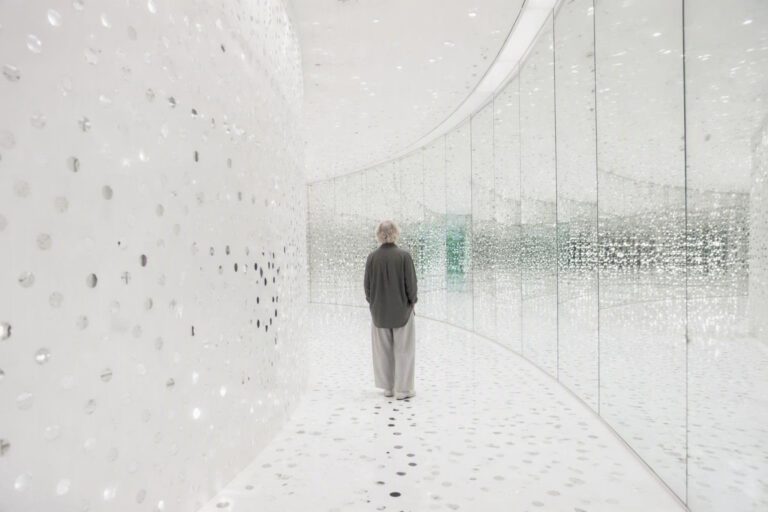
Yayoi Kusama, the Japanese artist whose hallucinations of dots and lights became a global phenomenon, has died at the age of 97. Her avant-garde creations, characterized by polka dotspumpkins and infinity rooms have left an indelible mark on the art world.
Kusama’s journey was as unique as her art. She voluntarily lived in a psychiatric hospital for decades, where she found solace and inspiration. Her vibrant works fetched some of the highest prices ever for a female artist, and her exhibitions drew massive crowds around the world.
From Obscurity to Global Fame
Kusama’s rise to fame was not without its challenges. In the 1960s, she faced criticism and scorn in the male-dominated art scene of New York. Her exhibitions of phallic sculptures and frequent displays of nudity caused a stir.
Despite these obstacles, her work gained traction, and in 1965, her Infinity Mirror Rooms attracted millions of visitors.
However, Kusama felt distressed when her ideas were copied by male contemporaries like Andy Warhol and Claes Oldenburg. This led her to return to Japan, where she checked herself into a psychiatric facility. The supportive environment allowed her to focus on her art, leading to a resurgence in her career.
A Pioneer in Art Therapy
Kusama’s art was a means of survival. She once said, “I fight pain, anxiety, and fear every day, and the only method I have found that relieved my illness is to keep creating art.” Her work depicted uncharacteristically dark series of collages in the 1970s, embracing the imagery of natural life cycles.
Her breakthrough came when she became Japan’s first solo artist to represent the country at the 1993 Venice Biennale. The success of this exhibition transformed her reception both in Japan and abroad. In 2001, she was awarded the Asahi Prize, recognizing her outstanding contributions to art.
Infinity Rooms and Beyond
Kusama’s Infinity Mirror Rooms immersed visitors in a world of mirrors and lights, creating seemingly endless spaces. These installations became a hallmark of her artistry, drawing huge audiences. One of her paintings fetched about $10.5 million at auction in 2026, making her works some of the highest-earning for a female artist.
Her exhibitions at prestigious venues like the Tate Modern in London were extended multiple times due to their popularity. Catherine Wood, interim director of Tate Modern, described the experience of stepping into an Infinity Mirror Room as “looking into the mysteries of the Universe.”
Kusama’s art was deeply personal. She used her hallucinations of dots and lights as inspiration, creating extraordinary immersive worlds that delighted millions. Her museum’s bold floral shapes and shiny steel orbs became popular backdrops for selfies and poses, fueled by social media.
Among her many motifs, the pumpkin became iconic. To her, it represented comfort and nostalgia. Kusama once said, “Pumpkins are my soul.” Her art continues to inspire and captivate audiences worldwide, leaving a lasting legacy in the art world.
