

In the heart of Knightsbridge, a £210m mansion with 45 rooms stands empty. Meet Anders Fernstedt, who has made the porch his home for three years.
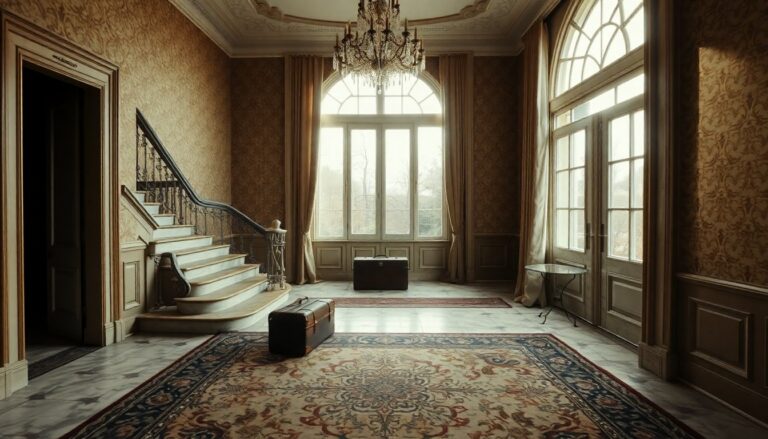
The most expensive house in Britain, 2-8A Rutland Gate, is not just a house but a palace in the heart of Knightsbridge. With 45 rooms, four lifts, an indoor pool, and 116 windows, 68 of which overlook Hyde Parkit’s a marvel of luxury.
Yet, it has been empty for years. The only sign of life is a makeshift tent on the porch, home to Anders Fernstedt, who has lived there for three years.
Fernstedt’s life on the porch is a stark contrast to the opulence inside.
He pees into a plastic bottle, navigating what he calls “Everest base camp problems.” His porch is filled with an eclectic mix of belongings, from baskets and books to flowers and bicycles. Despite his circumstances, Fernstedt is cheerful and well-connected, known to many of his neighbors, including a retired Azerbaijani ambassador.
The History of 2-8A Rutland Gate
The mansion’s history is as intriguing as its current state. Originally a row of houses, it was converted into a single property in the early 1980s by billionaire Rafik Hariri, who later became the prime minister of Lebanon. Hariri lived like a king, even covering wastepaper bins in 24-carat gold leaf, until his assassination in 2005.
After Hariri’s death, the home was given to Sultan bin Abdul Aziz, the crown prince of Saudi Arabia. When he died in 2011, the contents of the house, including jewel-encrusted bathroom suites and gold bins, were auctioned off in 2015. Despite a record-breaking sale in 2026, the house has remained empty. The last sale was to Hui Ka Yan, the founder of the property empire Evergrande, who has since faced financial troubles and legal issues.
The Story of Anders Fernstedt
Fernstedt’s journey to the porch of 2-8A Rutland Gate is a tale of resilience and adaptability. Born in Sweden, he worked as a journalist and later studied horticulture. His life took a turn when he was run over in South Carolina, fracturing his spine in three places. He recovered fully and moved to London, where he worked briefly at the Economist before becoming a freelancer.
Fernstedt’s life on the streets began in 2019 when he was living in a tent on a cricket ground in North London. He moved through various temporary accommodations, facing evictions and assaults, before ending up at 2-8A Rutland Gate. He has been there ever since, gradually accumulating belongings and making the porch his home.
The Housing Crisis in London
The story of 2-8A Rutland Gate and Anders Fernstedt highlights the housing crisis in London. In 2026, there were more than 300,000 long-term empty homes in England alone, with London having the highest number of empty homes and the most pressing housing needs. The city has 340,000 households waiting for somewhere to live, yet many new buildings are luxury apartments that don’t house poor or homeless people.
Organizations like Action on Empty Homes and Shelter are working to address this issue. They propose strengthening compulsory purchase powers, disincentivizing homes being left empty, and converting empty homes into social rent homes. However, the problem is complex and requires a multifaceted approach.
As Fernstedt says, he is “so close” to the luxury inside the mansion, separated only by a front door. His story, and the story of 2-8A Rutland Gate, is a poignant reminder of the stark contrasts and inequalities in our society.
