Former Myanmar leader Aung San Suu Kyi has been relocated to a designated residence under house arrest after a series of sentence commutations and mass amnesties
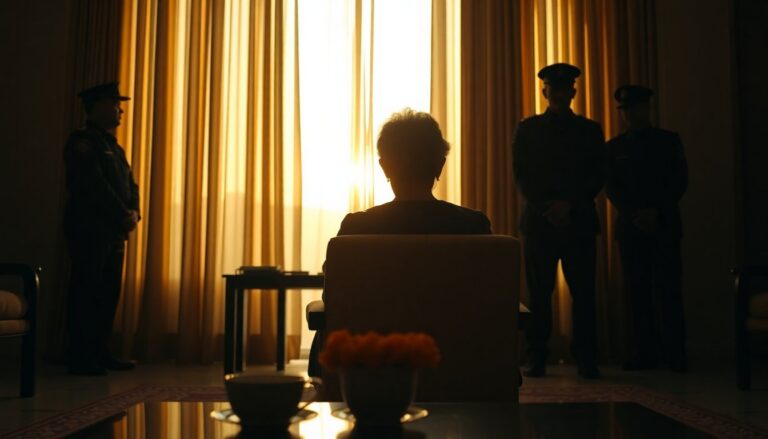
The military government in Myanmar has announced that former state leader Aung San Suu Kyi has been shifted from an undisclosed detention facility to a designated residence, effectively placing her under house arrest. State media released a photo of the 1991 Nobel Peace Prize laureate seated with uniformed guards, marking the first widely circulated image of her in years.
Officials said the move followed a set of prisoner clemencies tied to a Buddhist holiday, which included both the release of thousands and a broad reduction in remaining sentences for convicted inmates.
The transfer and official rationale
Myanmar’s commander-turned-president, Min Aung Hlaing, issued a statement saying he had “commuted the remaining sentence to be served at the designated residence”, a phrasing the authorities used to describe the legal change.
State outlets added that an amnesty freed 1,519 people, including 11 foreign nationals, and that the sentences of other convicted prisoners had been cut by one-sixth. This move followed an earlier, larger clemency on April 17 that granted freedom to more than 4,500 detainees.
The government framed these steps as part of a broader push for social reconciliation and stability after Min Aung Hlaing’s inauguration on April 10.
Legal implications and sentence calculations
Observers note that the adjustments to Suu Kyi’s penalties do not amount to an unconditional release. She was originally sentenced to 33 years in late 2026 on a series of counts widely described by critics as politically motivated. State media and legal calculations indicate that the recent commutation would reduce that total to roughly 18 years, leaving more than 13 years still to be served. Lawyers for Suu Kyi reported they received no direct notification of the new status and learned of the change through media reports, underscoring the opaque legal processes under the junta.
Health, family contact and access to counsel
Information about Suu Kyi’s health and conditions remains tightly controlled. Reports during 2026 and 2026 suggested declining health, with claims of low blood pressure and dizziness, though independent verification has been limited. Her family and legal team have faced severe restrictions: relatives say they have had no reliable contact in years, and lawyers have not met her in person since December 2026. Human rights groups and advocacy organisations continue to press for transparent medical checks and unimpeded legal access as part of any meaningful change in detention status.
Domestic reaction and the wider detention landscape
The transfer occurs against the backdrop of a prolonged and bloody confrontation that followed the 2026 military coup. The takeover provoked mass protests, brutal crackdowns and a civil conflict that rights groups say has killed thousands. According to the Assistance Association for Political Prisoners, more than 22,000 people have been detained since the coup, a figure that highlights the scale of the junta’s suppression of dissent. While the release of other figures, such as former president Win Myint, was noted by regional diplomats, Suu Kyi’s continued legal restrictions signal the limits of what the military appears willing to concede.
International and regional responses
International actors responded cautiously. The United Nations described the move as a potentially meaningful step toward conditions that could permit a credible political process, while reiterating calls for the swift release of all political prisoners. ASEAN’s chair, the Philippines, urged further prisoner releases and highlighted the need for steps that would genuinely support national dialogue. Diplomatic exchanges—such as a recent Thai engagement in which concerns for Suu Kyi’s welfare were raised—suggest regional pressure is being applied, though statements from Myanmar’s leadership have remained deliberately vague about any path to full liberation.
What comes next
Analysts say the move to house arrest may signal a limited tactical shift by the junta: an attempt to soften international criticism while preserving core control. For domestic observers and Suu Kyi’s supporters, the change is welcome but insufficient without transparent legal processes, guaranteed medical care and the release of all political detainees. As the situation develops, attention will focus on whether this measure leads to genuine political openings or remains a narrowly calibrated concession designed to reshape Myanmar’s international optics without altering the military’s hold on power.