A concise look at the Oakcastle BK100 and why its blend of connectivity, punch and price make it an unexpected bargain
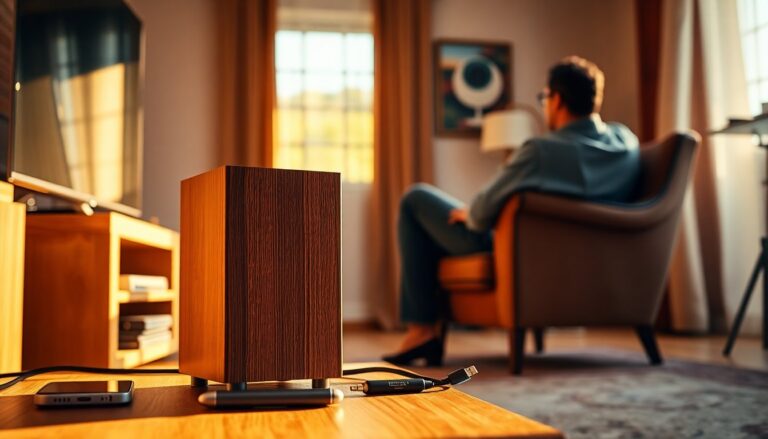
The Oakcastle BK100 arrives with a specification that sounds far more expensive than its sticker price of £69.99. Designed in Cambridge, these active speakers pack a claimed 60W of output spread across four separate drivers, and they support modern inputs including Bluetooth 5.4, HDMI ARC, optical, USB and AUX.
For readers wondering what a compact system like this is intended for, consider bookshelf speakers as a flexible audio solution: they can live on a shelf, a TV stand or a desk while offering true stereo imaging that soundbars typically cannot match.
Physically the BK100s present a restrained look that avoids the gamer RGB aesthetic and instead leans on simple lines and exposed cones. That visual choice pays off in neatness but brings a trade-off: the drivers have no protective grilles, so they are more susceptible to damage from curious fingers or accidental knocks.
Internally, the set includes built-in subwoofer capability that delivers satisfying low end—enough to add depth to music and movies without requiring a separate subwoofer—making these well suited to mid-sized rooms rather than vast living spaces.
Design and connectivity
Oakcastle puts the controls discreetly on the side of the right speaker, preserving the minimalist front. The control layout allows users to tweak bass and treble directly on the unit, though there are no saved EQ presets to store different listening profiles. The array of rear and digital connections is impressive at this price: HDMI ARC for easy TV hookup, optical for digital audio, USB for playing MP3 files and a traditional AUX input. The presence of Bluetooth 5.4 means wireless streaming is straightforward and responsive, and the speakers will happily play tracks from a USB drive—an oft-missed feature on budget systems.
Inputs and controls
While connectivity ticks many boxes, the remote control relies on infra-red (IR) rather than a wireless RF or app-based system. That means the remote must be aimed reasonably accurately at the right speaker to register commands; range and angle are limited compared with modern Bluetooth remotes. Also, the remote cannot adjust the onboard bass and treble settings, which must be altered at the speaker. There is no headphone passthrough jack, so private listening requires separate equipment, but the BK100s do cover the essentials for most living-room and desk setups.
Sound performance
With two drivers per cabinet the BK100s deliver a surprisingly full soundstage for their size. The twin smaller drivers contribute clear mid and high frequencies while the larger drivers handle lower frequencies, producing bass that reaches down to around 30Hz in practice without becoming muddy at elevated volumes. This combination gives the speakers strong stereo separation, so instrument placement and directional audio cues in films feel more natural than they would on a single-bar soundbar. For everyday listening—pop, rock, electronic or film soundtracks—the presentation is detailed and lively.
Bass and clarity in practice
In real-world listening the BK100s are capable of pushing a complex track with authority and retain compositional detail even when asked to perform loudly. Movies benefit from the added low-end weight and the clear midrange, allowing dialogue and subtle soundtrack elements to remain intelligible. They do not simulate a multi-channel surround setup, so you should not expect immersive Dolby Atmos precision, but they do a markedly better job than typical TV speakers and many entry-level soundbars when it comes to musicality and separation.
Value and verdict
The most compelling part of the Oakcastle BK100 package is the balance between features and price. From an award-winning British maker, these speakers offer modern connectivity, onboard EQ, USB playback and true stereo cabinets for £69.99—a combination rarely seen at this cost. Downsides are mostly cosmetic and ergonomic: exposed drivers need care, the IR remote has a narrow reception window and there is no headphone output or multiple EQ presets. Even so, for anyone upgrading a TV’s tinny speakers or equipping a gaming/desktop space without breaking the bank, the BK100s represent a smart, hard-to-ignore option.