Scotland's SNP government outlines a bold overhaul of local councils, aiming for fewer regional authorities, but the financial and democratic impact remains uncertain.
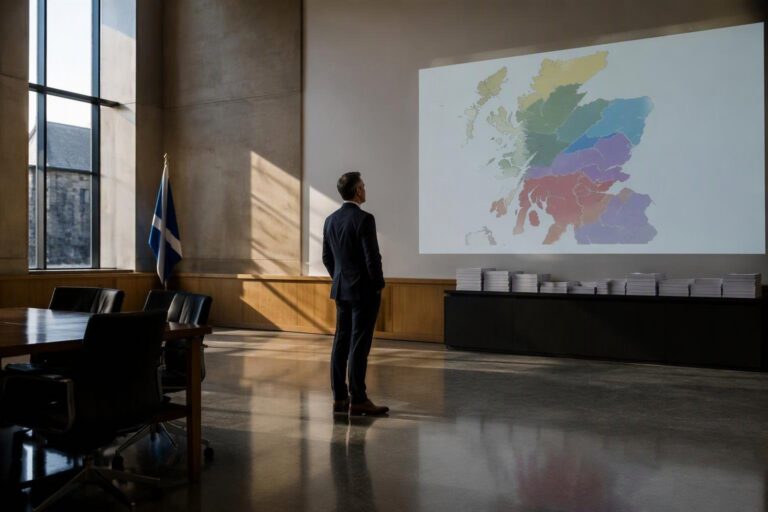
The Scottish government has released a consultation paper that would dismantle the existing 32 local councils on the mainland and substitute them with a handful of larger regional authorities. The draft envisions between six and ten new regions, each supported by up to 160 community councils designed to preserve local input.
The move is framed as a response to a projected funding shortfall that could approach £5 billion by 2030, alongside a current operating deficit of more than £2 billion.
How the new structure would work
Under the proposal, the newly formed regional bodies would inherit strategic responsibilities such as housing, planning and transport, functions that are presently administered by Holyrood.
The paper describes these powers as an enhanced role in regional economic development and business support allowing decisions to reflect local strengths and ambitions. Councillors elected from existing wards would hold a dual mandate serving on both a community authority and its associated regional authority, with the expectation of higher remuneration to reflect the added duties.
Community authorities – numbered between 120 and 160 – would focus on hyper-local matters, ensuring that decisions remain close to residents. For island communities, separate arrangements are promised, although details remain sparse. The consultation stresses that the model would avoid adding a new electoral layer, thereby keeping bureaucracy in check while aiming for greater strategic coordination.
Political dialogue and timetable
Deputy First Minister and finance secretary Jenny Gilruth emphasized the urgency of reform, noting that the government has deliberately set a three-month window that would conclude around the beginning of December. She told the BBC that the process would not extend beyond next May’s local elections, stating, “No. We’ve quite deliberately actually set quite a tight time period of three months.” Gilruth also warned that the ultimate shape of the reforms will be heavily influenced by the upcoming UK government budget, which will dictate how much funding the SNP can allocate to the restructuring.
Critics have seized on the lack of concrete numbers for job losses or savings. The Scottish Conservative local-government reform spokesperson Alexander Burnett accused the SNP of “half-baked measures” and claimed that the government “doesn’t have a clue about the consequences.” Meanwhile, Labour’s local-government spokesperson Joe Fagan cautioned against another re-organisation without solid partnership with existing councils and adequate funding.
Financial expectations and open questions
Gilruth described any fiscal benefit as a “long-term ambition,” arguing that the new model would naturally generate efficiencies by eliminating “massive duplication” across the current system. She added that savings would arise from a more streamlined approach rather than immediate cuts. The consultation paper itself acknowledges that the exact magnitude of cost-reduction remains uncertain, and the government has refrained from publishing specific job-cut figures.
Cosla, the umbrella body for Scotland’s local authorities, welcomed the opportunity for dialogue but warned that reforms must “enhance local democracy and bring decisions closer to communities.” Its president, Shona Morrison said Cosla will evaluate the proposals and continue constructive discussions.
The next weeks will see extensive consultation, and the final direction will be shaped by both political negotiations and the outcome of the UK budget.