Prime Minister Andy Burnham and First Minister John Swinney agreed to explore new powers for Scotland after a constructive Glasgow summit.
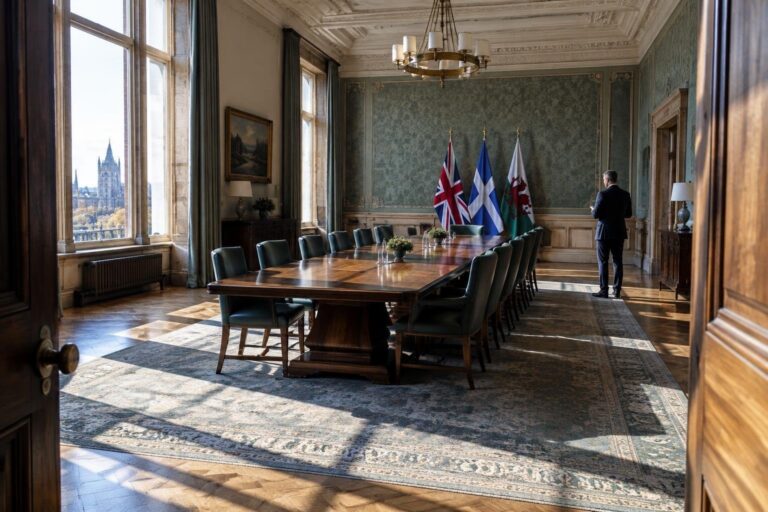
In a high-profile session held at the National Economic Council in Glasgow, Prime Minister Andy Burnham sat down with Scotland’s First Minister John Swinney and the Welsh leader Rhun ap Iowerth. The gathering also welcomed a delegation from Northern Ireland, although its first minister was absent due to intra-government tensions.
The agenda centred on extending the recent English-style regional devolution to the rest of the United Kingdom, with a particular focus on empowering Scottish and Welsh regions.
Burnham opened the dialogue by stressing the need to avoid any part of the union being “left out”.
He argued that the “growth can’t wait” and that “power to the people” should flow not only from Westminster to Holyrood but also down to local authorities across Scotland. The Prime Minister’s language repeatedly echoed the phrase problem solving rather than point scoring, signalling a shift from partisan posturing to collaborative policymaking.
Key commitments emerging from the Glasgow summit
The two leaders highlighted several areas of agreement. Swinney described an “alignment” in their aspirations for local and regional government, and both pledged to pursue deeper devolution of employment support, re-industrialisation funding, and fiscal tools. Burnham cited his experience in Greater Manchester, noting that “when you’ve got power at that level, local people can come together with businesses and start to solve things”. He promised that the UK government would launch a policy sprint led by No10 North, involving officials from both sides of the border, to flesh out the details.
In parallel, the Welsh First Minister echoed similar goals, insisting that any further powers must be decided by the Senedd. He also pressed for “structures at a regional level” that would address youth unemployment across the nations. Both sides agreed that the next step would be a joint review of proposals, with the UK government committing to respond to the issues raised by Holyrood, while keeping the prospect of a second independence referendum “off the table”.
Points of friction and the limits of the agreement
Despite the upbeat tone, underlying tensions resurfaced. Defence Secretary Wes Streeting publicly criticised the Scottish administration for “hoarding” powers transferred from Westminster, urging a cascade of authority from Holyrood to local councils. This remark sparked a brief backlash, with a Scottish official describing it as a lecture on devolution. Moreover, Swinney reiterated his intent to “apply pressure and mobilise opinion” for an independence referendum within the current parliamentary term, a stance the Downing Street spokesperson dismissed as “off the table”.
The meeting also revealed divergent views on fiscal devolution. While Burnham pointed to the recent UK budget’s provisions for English city-region tax powers, he insisted that Scotland and Wales should not be excluded from similar schemes. Yet Welsh representatives warned that the budget effectively delivered a real-terms funding cut for Wales, questioning the Prime Minister’s commitment to genuine parity.
Next steps and the road ahead
Both governments said a concrete action plan would be drafted by officials from No10 North, with a focus on regional empowerment, re-industrialisation, and employment programmes for young people. The Prime Minister reiterated that “we need to get more power down into more parts of Scotland” to stimulate growth, and the First Minister promised to work “constructively and collaboratively” to secure those powers from Westminster. While the summit produced a “positive response”, the unresolved issue of Scottish independence and the scepticism over fiscal parity indicate that the partnership will require ongoing negotiation.
The Glasgow dialogue marked a rare moment of cross-government cooperation, laying the groundwork for a more devolved United Kingdom. Whether the pledged “common ground” will translate into tangible powers for Scotland and Wales remains to be seen, but the parties have signalled an intention to keep the conversation alive, avoiding “point scoring” in favour of practical solutions for every postcode across the union.