Police, politicians and courts collide as an Orange Order march is halted on Garvaghy Road.
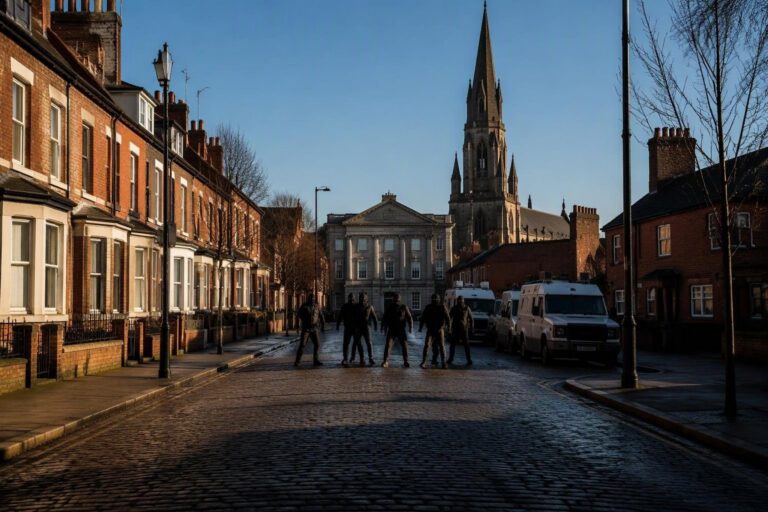
In the early hours of Sunday, a crowd of protestors transformed Portadown’s Garvaghy Road into a flashpoint for Northern Ireland’s most volatile political fault line. The road, which leads from Drumcree Church, was blocked by thousands of residents, many wearing balaclavas, intent on preventing an Orange Order parade that has been forbidden since 1998.
The blockade was not a scheduled demonstration; it failed to obtain the notification required by the Parades Commission a statutory body that must approve any public march. Police officers repeatedly warned the assemblage via loudspeaker that the obstruction was unlawful and that arrests would follow.
Blockade on Garvaghy Road
At roughly 8 am, the parade’s earliest start time, the protesters’ presence delayed the procession, forcing the Orange Order marchers to remain at Drumcree Church a mile away. By 6 pm, a limited group of thirty-five Orangemen descended the hill, adhering to the commission’s strict cap on participants.
The restriction, imposed to contain potential disorder, was communicated by police who reminded the marchers they could not exceed the 35-person limit. Senior Sinn Féin figures, including First Minister Michelle O’Neill joined the demonstrators, underscoring the political weight of the stand-off.
Police response and community impact
Chief Constable Jon Boutcher of the Police Service of Northern Ireland (PSNI) described the operation as proportionate and evidence-driven, emphasizing that “the police have been gathering evidence of actions by all parties from the start”. He called for a “sensible and peaceful conclusion” and urged both sides to sustain a longer-term dialogue. In the meantime, local services felt the ripple effect: the Irish-medium primary school on Garvaghy Road announced a closure for the following day, citing safety concerns for pupils, families and staff.
Court rulings and legal context
The legal battle surrounding the march reached a climax in an “unprecedented” late-night hearing. At 2.15 am on Sunday, Justice Michael Humphreys of the High Court upheld the Parades Commission’s decision to allow the Orange Order to proceed along Garvaghy Road, citing the need to respect the commission’s expertise and the lack of a “reasonable” basis to overturn it. He noted that the court could not substitute its own view for that of the commission. Earlier that night, at 12.20 am, the same court had reaffirmed this stance after hearing arguments from both legal teams.
Earlier challenges had produced divergent outcomes. Justice Patricia Smyth temporarily blocked the commission’s ruling, warning that the “long-running dispute has the potential to escalate”. However, the Court of Appeal, led by Lady Chief Justice Siobhan Keegan and joined by Lady Justice Denise McBride later upheld an appeal by Portadown Orangeman Alan Hynes permitting the march to proceed under strict conditions. The series of emergency applications highlighted how the dispute has been thrust into the highest echelons of the judicial system.
Political leaders urge compromise
Amid the courtroom drama, political figures raced to the scene. Sir Chris Bryant Northern Ireland Secretary, arrived from the Labour Party conference in Liverpool and publicly appealed for calm, urging “double-down on compromise”. He warned that “nobody wants to go back 28 years”, a clear reference to the Troubles era. Sinn Féin president Mary Lou McDonald called on the secretary to intervene and ban the march, insisting the people of Garvaghy Road would “not be drawn back to the past”.
DUP leader Gavin Robinson blasted the involvement of Sinn Féin ministers, stating, “We can’t have a situation where people who have the privilege of holding high office in Northern Ireland so flagrantly disregard the pledge of office and statutory underpinnings of their office.” He pledged to maintain “the dignity of the Portadown Orangemen” and warned that the “fundamental principle of upholding the rule of law…is sacrosanct”.
First Minister Michelle O’Neill addressed the crowd directly, urging protesters to remain on the road until at least midnight, emphasizing that “the people of Garvaghy Road need us to stay with them tonight”. Meanwhile, Prime minister Andy Burnham and Irish Taoiseach Micheál Martin both issued statements urging restraint, with Martin describing the commission’s permission as “incomprehensible and wrong”.
The cumulative pressure from the judiciary, law enforcement, and political leadership showcases how a single parade can become a crucible for the entire power-sharing arrangement in Belfast. With Stormont’s stability hanging in the balance, every statement, legal judgment, and police maneuver is being closely watched as both sides navigate a path that avoids reigniting the most painful chapters of Northern Ireland’s recent history.