

Google, GM, and third‑party kits are reshaping what drivers and passengers can do inside their vehicles, from parked‑only gaming to split‑screen smartphone integration.
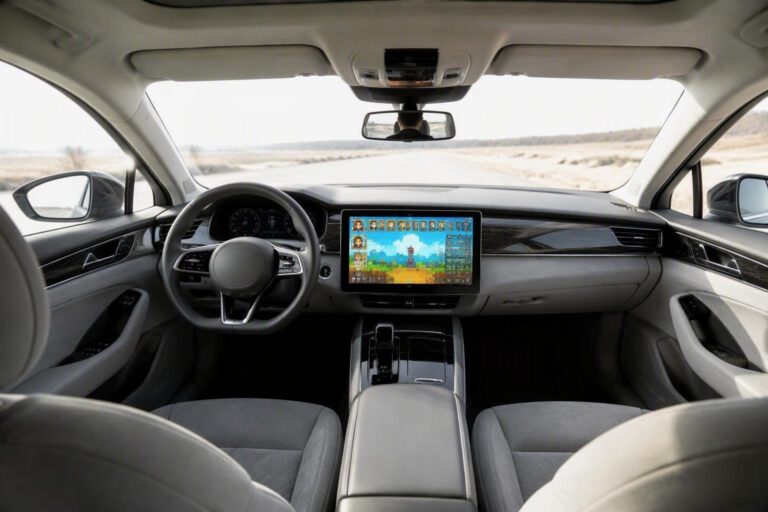
In a week packed with automotive software news, three distinct developments are converging on the same goal: turning the vehicle cabin into a more versatile entertainment hub. Google announced that its Android Auto gaming feature will move out of beta and become generally available, while General Motors revealed a split-screen implementation of Apple CarPlay and Android Auto for its 2027 Silverado and Sierra pickups.
At the same time, affordable aftermarket screens are giving owners of older cars access to real-time navigation, voice assistants, and streaming services without a costly factory retrofit.
Android Auto gaming goes public
On September 22, 2026, Google confirmed that compatible games will finally be listed in the official Android Auto catalog, ending the experimental phase that limited titles to a handful of beta testers.
The rollout is slated for October 15, 2026 and will arrive as a free software update, meaning no extra fee for owners of supported head units. According to supply-chain leaks, the baseline hardware needed includes 4 GB of RAM a processor comparable to the Qualcomm Snapdragon 8 Gen 1 or newer, and at least 64 GB of internal storage for cached game data.
Displays must support a minimum resolution of 1920 × 1080 pixels and the system will draw up to 15 W of USB power while a game is running.
The safety model stays untouched: games are only launchable when the vehicle is stationary. The software automatically blocks gameplay during motion, ensuring that the driver’s attention remains on the road. This design steers the feature toward idle moments—charging stations, pickup zones, or simply a parked car—rather than becoming a distraction while driving. Developers can now submit titles through Google Play’s open-testing and production tracks, widening the ecosystem beyond Google’s curated list.
GM brings split-screen CarPlay and Android Auto to its trucks
Three years after removing phone projection from its lineup, General Motors announced that the 2027 Chevrolet Silverado 1500 and GMC Sierra 1500 will once again support Apple CarPlay and Android Auto. The twist this time is a window-in-window layout that coexists with the truck’s native interface. Instead of commandeering the entire screen, the smartphone apps appear in a dedicated pane while the vehicle’s own map, trailer-load meters, and settings remain visible.
The hardware makes the split feasible: a standard 16.3-inch center touchscreen pairs with a 12.2-inch instrument cluster, and higher trims add an 11.5-inch passenger display, a 15-inch head-up display, and an 8.5-inch rear-camera mirror. All together they total roughly 63.5 inches of glass. The passenger screen is polarized to block driver view and runs Disney+, YouTube, Hulu, Amazon Music, and a web browser, with audio routed to either Bluetooth headphones or the cabin speakers. A lock button on the center console lets the driver disable the passenger screen—ideal for parental control.
GM claims ongoing collaboration with both Apple and Google to refine the experience. Because the truck’s native OS already runs on Android, the integration of Android Auto is deeper than CarPlay’s, which still operates as a separate layer. The company has not yet confirmed whether the same split-screen functionality will roll out to its electric models, though the underlying software architecture is described as a single scalable foundation for gasoline, diesel, and electric powertrains.
Cheaper ways to modernise older cars with Android Auto
Owners of legacy vehicles now have a budget-friendly path to contemporary infotainment via third-party screens that act as Android Auto head units. Products such as the Volam 11-inch Wireless CarPlay Screen (priced around $120) or the Open Headunit app enable a tablet or dedicated screen to plug into the car’s AUX input and connect to a smartphone over USB or Bluetooth. Once linked, the dashboard gains access to real-time navigation (Google Maps or Waze), hands-free voice controls and streaming apps, all displayed on a larger, more legible panel than a phone held on the dash.
Because the external screen draws its own power and handles audio, owners avoid the expense of a full factory replacement, which can exceed $500. Moreover, the setup remains flexible: the screen can be swapped, upgraded, or removed without permanent modifications to the vehicle’s wiring. Users benefit from continuous app updates and new features that OEM systems often abandon after a few years.
When paired with a compatible head unit, Android Auto’s split-screen capability lets drivers view navigation while interacting with music or messaging apps, and the built-in Google Assistant can read messages, place calls, or add items to a shopping list—all without taking eyes off the road. The combination of these three trends—Google’s broader game catalog, GM’s split-screen CarPlay, and affordable aftermarket Android Auto kits—illustrates a shift toward modular, safety-first entertainment that can be adopted across the entire vehicle lifecycle.
