

EE rolls out Match‑Maxxing, promising solid mobile signal for fans even in the most packed football arenas.
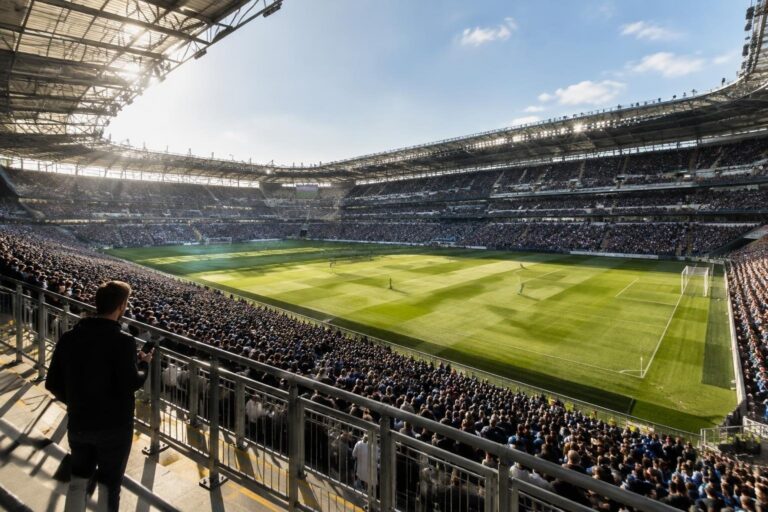
The moment a stadium door swings open, the roar of tens of thousands of supporters drowns out every other sound, and the invisible battle for a mobile signal begins. For years, fans of Liverpool, Manchester City and countless other clubs have learned to accept that their phones turn into paperweights once the stands reach capacity.
Whether it is checking the live score, sharing a goal on social media, or arranging a ride home, the lack of connectivity turns a simple celebration into a logistical headache. This chronic issue has become a silent pain point for anyone who has ever tried to post a video from the North Stand while the crowd is at its peak.
Enter EE, the UK’s largest mobile network, with a solution it calls Match-Maxxing. By extending its Fast Lane feature to the popular Full Works Plus tariff, the operator promises a dedicated data pipe that can survive the crush of simultaneous users inside a packed arena.
The service is marketed as a way for supporters to stay online without the dreaded “no signal” moments that usually accompany a full-house match. To illustrate the real-world impact, EE has partnered with one of the country’s most vocal football enthusiasts, Andy Milne – known online as ‘that_world_cup_guy’ – who will demonstrate the technology during live fixtures.
What is Match-Maxxing?
Match-Maxxing is essentially a traffic-management layer built on top of EE’s 5G+ infrastructure. When a user with an eligible plan steps into a venue that hosts a high-density event, the network automatically flags the device and routes its data through a dedicated high-capacity lane. This lane, branded as Fast Lane is insulated from the massive background traffic generated by thousands of other phones competing for the same towers. In practical terms, the feature behaves like a priority queue at a supermarket checkout – the user’s requests are processed first, reducing latency and preventing the usual drop-outs. The service works only with 5G+ compatible devices a 5G+ enabled SIM and a plan that includes the Fast Lane entitlement.
How the service copes with stadium crowds
Across the United Kingdom, an estimated 50 million spectators flock to football matches each year, creating a perfect storm for cellular networks. In a typical stadium, thousands of smartphones simultaneously attempt to upload videos, refresh live-score apps, and exchange messages in group chats. EE’s solution tackles this by allocating a reserved slice of spectrum exclusively for users who have activated Match-Maxxing. The network’s 5G+ nodes, already positioned around major grounds, dynamically increase their carrier aggregation to accommodate the extra load. Because the service is tied to the Full Works Plus contract, it also benefits from the plan’s higher data caps, ensuring that fans can stream a quick highlight without exhausting their allowance. Access is limited to areas where EE has rolled out 5G+, which currently covers most of the country’s major urban centres and sporting venues.
Andy Milne puts Match-Maxxing to the test
To make the promise tangible, EE invited Andy Milne the online personality who earned the moniker ‘that_world_cup_guy’ for his relentless coverage of international tournaments. Milne entered Anfield on a night when the stadium was at full capacity, activated the Fast Lane on his 5G+ handset, and recorded a series of side-by-side videos showing signal strength with and without Match-Maxxing. In the with scenario, his device maintained a steady 4G LTE-Advanced connection, allowing him to upload a 30-second clip of a goal in under five seconds. In the control test, the same clip stalled repeatedly, and the signal icon flickered to zero. Milne’s live-streamed commentary, posted to his social channels, provided a real-time benchmark that resonated with thousands of fellow fans.
Fans who wish to benefit from Match-Maxxing must ensure they are on a 5G+ compatible mobile plan possess a 5G-ready SIM and are located within a 5G+ covered zone at the time of the match. Detailed instructions, including how to enable Fast Lane on the Full Works Plus tariff, are available on EE’s official support page. As stadiums continue to fill to capacity, the rollout of this dedicated data lane could signal a broader shift toward sport-specific connectivity solutions, turning the once-frustrating silence of a dead signal into a steady stream of live updates.
