

Discover which cases, stands and apps truly unlock the iPhone Duo’s potential, plus a candid review of its ergonomics, screen quality and price.
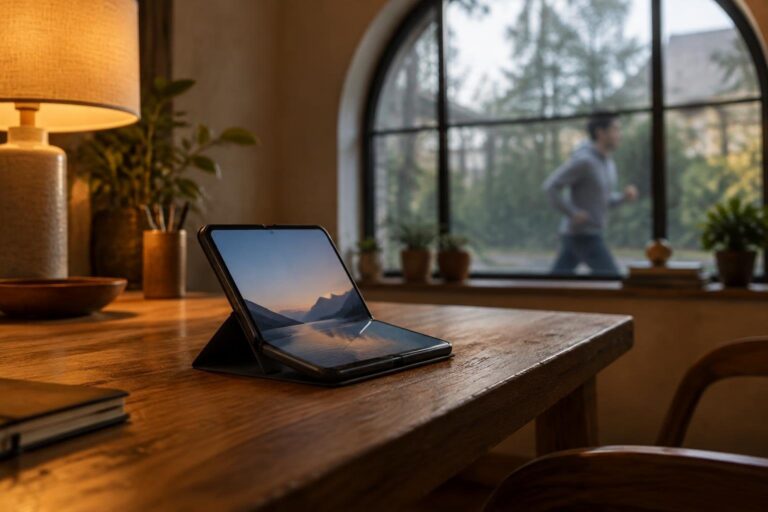
The iPhone Duo marks Apple’s first foray into the foldable smartphone segment, blending a traditional handset size with a tablet-like inner screen. Early adopters quickly learned that a device this thin when closed yet expansive when open benefits from accessories that protect the hinge, extend productivity and make the twin-screen experience painless.
Below we examine the most notable add-ons and then share impressions gathered after a full week of daily use.
Official and third-party accessories that amplify the Duo
Apple’s own ecosystem launches with a dedicated Folio that doubles as a kickstand.
Crafted from its proprietary TechWoven material, the case snaps onto the Duo via concealed magnets, guaranteeing a snug fit while preserving MagSafe charging alignment. The kickstand, positioned low on the back, lets the phone rest in portrait or landscape without additional hardware.
It is available in Navy Blue and Taupe for £129.
Premium docking stations
French design studio Bionic Labs unveils a minimalist dock that merges a charger, stand and Apple Pencil holder. Constructed from anodised aluminium and polished stainless steel, the dock offers an adjustable arm that can swing the Duo into a desktop-like posture. A recessed slot on the base secures the Pencil, turning the phone into a true note-taking companion. Customers can choose between black or silver finishes for €229.
Versatile wallets and cases
Moft’s Snap Fold combines a magnetic wallet with a dual-mode stand, attaching to the rear of the Duo whether folded or opened. The current palette includes Black and White, with Khaki Green and Terracotta slated for release. Its sibling, the Dynamic Folio, adds a full-coverage screen protector and a series of engineered creases that produce multiple viewing angles while also serving as a hand-grip. Prices sit at £39 and £54 respectively.
Mous counters the folding form factor’s inherent fragility with its Limitless Case. Reinforced TPU corners, a micro-fibre interior and a polycarbonate shell absorb impacts, while optional finishes—Aramid fibre, leather, fabric or walnut—lend a premium aesthetic. The case also integrates MagSafe compatibility and retails for £84.99.
For a more classic approach, Torro crafts a leather wallet that houses card slots on the left side and a built-in stand that accommodates both closed and opened states. Magnetic clips keep the Duo sealed, and the case supports MagSafe charging. It is priced at £39.99.
Portable power solutions
Better Mobile Xperience, a BMW-backed venture, introduces the SolidSafe Duo powerbank. It houses a 5,000 mAh semi-solid-state cell and a 360-degree rotating ring that doubles as a stand. Wireless output reaches 15 W, while a USB-C cable delivers up to 20 W wired charging. The unit costs £79.99.
Playful software extensions
Beyond hardware, the Duo’s twin screens invite creative apps. Tiny Computers offers a miniature museum of retro machines—original Macintosh, Amiga 500, early Windows PCs and a Commodore 64—each emulated for touch interaction. The app, priced at $3.99, showcases how developers can exploit the split-display layout for nostalgic entertainment.
Hands-on review: strengths, quirks and the price tag
After swapping an iPhone 18 Pro for the Duo, the most immediate adjustment involved unlocking the device. Apple replaced Face ID with a right-mounted Touch ID sensor to keep the bezels thin and free up space for the hinge. While familiar to long-time iPhone users, Touch ID feels slower than facial recognition, adding a brief pause before the Home screen appears. Muscle memory eventually develops, yet the extra step remains noticeable.
The Duo’s chassis is a Grade 5 titanium frame—Apple’s heaviest iPhone to date at 254 g, exceeding the iPhone 18 Pro Max’s 249 g and the Samsung Galaxy Z Fold 8’s 201 g. The premium alloy trades lightness for durability; during a week of everyday mishaps—minor drops, a splash, and tentative tent-mode usage—the phone retained a pristine finish without dents or scratches.
Ergonomics present a mixed picture. When folded, the 5.4-inch OLED front panel stretches horizontally, resembling a passport cover. Holding it with a pinky on one edge and a thumb on the opposite feels natural, yet reaching the screen’s far corners can be a stretch, especially for users with smaller hands. The low-mounted MagSafe ring means many accessories, such as larger wallets or battery packs, hang off the side, requiring careful balance.
Volume controls sit atop the device rather than the side, a decision Apple justifies by noting the Duo may be used in portrait, landscape or tent orientation. In practice, the placement leads to occasional mis-presses of the power button, locking the screen unintentionally. A visual cue—perhaps a subtle LED indicator—could alleviate this friction.
The crown jewel remains the inner 7.6-inch LTPO OLED display. Its nano-texture matte coating reduces glare, delivering uniform colour and brightness even under bright daylight. The surface feels smooth enough for Apple Pencil scribbles, a capability still missing from most Android foldables. A fine crease is present at the hinge, visible only from sharp angles, and it becomes slightly more pronounced with repeated folds, but it never detracts from the overall viewing experience.
Performance-wise, the Duo houses Apple’s latest chipset, delivering fluid multitasking and sustained battery life that comfortably exceeds a typical workday. However, the starting price of $2,000 positions it at the high end of the market, and the lack of a dedicated telephoto lens may deter photography enthusiasts.
Finally, the software ecosystem is still catching up. While flagship apps run flawlessly, a significant number of third-party applications have yet to optimise for the dual-screen layout, resulting in occasional letterboxing or duplicated UI elements. Early adopters should expect a gradual rollout of updates that will unlock the full potential of the form factor.
