Dutch artist Berry Dijkstra turns furniture into towering sculptures, blending design, color, and composition in a playful architectural dance.
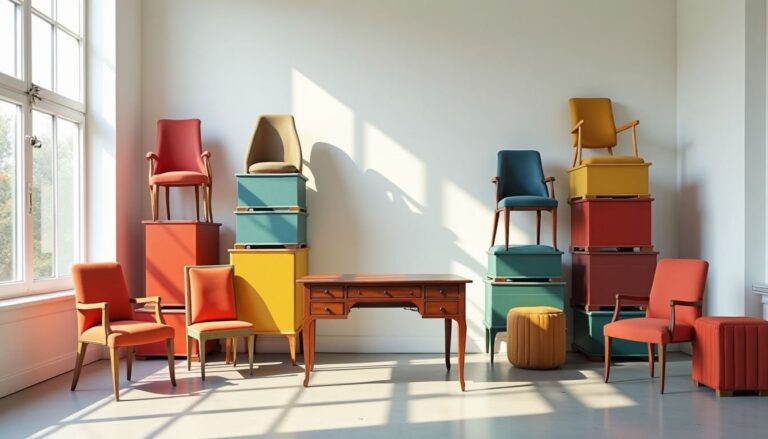
In the world of contemporary art, few creatives have embraced the concept of stacking with as much enthusiasm and innovation as Dutch artist Berry Dijkstra. His work transforms ordinary furniture into towering, colorful sculptures that challenge conventional notions of design and architecture.
Dijkstra’s approach is both playful and methodical resulting in installations that are as visually striking as they are thought-provoking.
Dijkstra’s journey into stacking began almost serendipitously. While living in Rotterdam, he started experimenting with small assemblages of objects.
Over time, his creations grew in scale and complexity, evolving into imposing structures that reach the ceiling. These installations are not merely piles of furniture; they are carefully curated compositions that balance color, material, and form to create a sense of harmony and tension.
From Small Assemblages to Large-Scale Installations
The transition from small-scale assemblages to large-scale installations was a natural progression for Dijkstra. His early experiments with small objects laid the groundwork for his later work, which often features armadi, tavolini, and sedie, along with lampade, vasi, and even busti greco-romani. These elements are meticulously arranged to create structures that are both stable and dynamic, with a delicate balance of equilibrium and friction.
Dijkstra’s work has caught the attention of several prominent brands, including the Polish furniture producer Tylko and the Dutch bedding brand Suite702. His installations have also been featured in design boutiques and events such as the Design Biennale Rotterdam. These collaborations have allowed him to showcase his unique vision on a larger scale, reaching a wider audience and solidifying his reputation as a pioneer in the field of stacking art.
The Philosophy Behind the Stacks
For Dijkstra, stacking is more than just a creative endeavor; it is a form of architectural expression. He describes his creations as “a sort of architecture, similar to an urban landscape, that in photography would appear flat.” This perspective highlights his focus on the three-dimensional aspects of his work, emphasizing the importance of color, material, and composition in creating a visually engaging experience.
The key to a successful stack, according to Dijkstra, lies in the balance between equilibrium and friction. Each element must be carefully placed to ensure stability, while also creating a sense of movement and dynamism. For example, a lampada da tavolo Oceanic by Michele De Lucchi might be placed on a cassettiera rosa bubblegum by Tylko, creating a vibrant contrast that draws the eye. Similarly, a lampada da parete by Barry Llewellyn, made from fragments of recycled ceramic and glass, might be paired with a scala by Malva Office, adding an element of whimsy to the composition.
A Curated Collection of Eclectic Elements
Dijkstra’s installations are a testament to his eclectic taste and keen eye for design. His collection includes pieces from a variety of sources, ranging from vintage markets to contemporary designers. One of his early passions was Pastoe, a Dutch brand known for its mid-century credenze and minimalist furniture by Aldo van den Nieuwelaar. Over time, his focus has shifted towards younger, contemporary designers, resulting in a mix of graphic and minimalist elements that define his unique aesthetic.
Among the standout pieces in his collection are a vivace sedia verde neon from the Splitted collection by Teun Zwets, a sgabello in olmo by Kasper Boelens, and a luce al neon by Sabine Marcelis. These elements, along with piante da casa in feltro di lana by the Rotterdam-based collective Wandschappen, contribute to the eclectic and vibrant nature of his installations. Dijkstra’s ability to blend these diverse elements into cohesive compositions is a testament to his creative vision and artistic prowess.
In the ever-evolving world of contemporary art, Berry Dijkstra’s stacking installations stand out as a unique and innovative form of expression. His work challenges conventional notions of design and architecture, transforming ordinary furniture into extraordinary sculptures that captivate and inspire. As he continues to push the boundaries of his craft, Dijkstra’s contributions to the world of art and design are sure to leave a lasting impact.