A planned three-day Ijtema at Shrubland Hall has drawn national attention as organisers and residents clash over scale and logistics
The quiet Suffolk village of Barham, near Ipswich, is at the centre of a controversy after organisers announced a large religious gathering at the nearby Georgian estate Shrubland Hall. The event, described as a three-day Ijtema (a large congregational meeting), is being organised by a UK charity linked to the Markazi Mosque in Dewsbury and is scheduled for July 10th-12th 2026.
Residents have raised concerns about whether a community of roughly 1,600 people can absorb the influx and accommodate the event’s services, transport needs and waste management.
The organisers are operating under the name London to Nizamuddin, registered with the charity Anuman-e-Islahul Muslimeen, which lists activities including the running of a mosque.
Promotional material for the gathering highlights Shrubland Palace as a secluded venue with extensive grounds and parking. A video accompanying the announcement speaks of spiritual renewal and references the expected arrival of a senior religious figure, named as the World Amir Sheikh Saad, whose presence the organisers say will be a focal point of the programme.
The itinerary is said to include collective prayer, communal meals and religious lectures.
Organisers, intentions and attendance figures
The host mosque, Markazi Mosque, is known as the European headquarters for the Tablighi Jamaat movement, an evangelical Sunni network. Organisers initially publicised eye-catching attendance projections—at one point citing up to 100,000 people—but that figure has since been revised down, with subsequent statements indicating a target closer to 10,000 attendees. Locals and planners worry the difference between the initial estimates and the later number does not remove the logistical challenge; even a crowd of 10,000 would place heavy demands on local roads, emergency access and neighbourhood services.
Local reaction and practical concerns
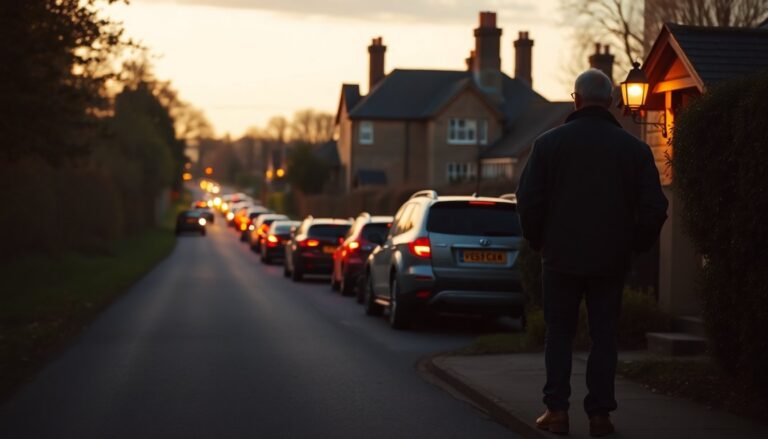
Barham residents discovered advance preparations when people were reportedly seen in the village arranging marquees near a local Co-op. Neighbours say the sudden activity and sparse consultation have been unsettling. Critics have commented on the narrow rural roads leading into the estate and have done rough calculations to underline their fears: using a modest average of four people per vehicle, thousands of attendees could translate into tens of thousands of cars seeking access and parking. The organisers’ claim of “unlimited parking” on the estate has been questioned by residents and transport specialists alike.
Traffic management and community impact
Transport experts note that temporary events of this scale require carefully planned access routes, stewarding, and liaison with local authorities for signage, traffic control and emergency corridors. The estate’s proximity to small lanes and villages means any influx could create bottlenecks and pressure on public services. For villagers, the concern extends beyond traffic to include noise, overnight stays, sanitation and the capacity of local medical and policing resources to cope with a concentrated surge in visitors.
Background: the movement and the venue
An Ijtema is a recurring form of large-scale assembly associated with the Tablighi Jamaat, whose global gatherings include the well-known Biswa Ijtema in Bangladesh and the Raiwind Ijtema in Pakistan. The movement has tens of millions of adherents worldwide and focuses on missionary work and devotional practices. The Markazi Mosque has been referenced in media coverage for historical reasons, including reports that two of the 7/7 attackers once attended the mosque; the mosque has denied regular involvement by those individuals and has rejected suggestions that it promotes radicalisation.
Shrubland Hall: a brief history
The chosen venue, Shrubland Hall, dates back to the 1770s and has a long history as a private country house. It was sold in 2006 by Baron de Saumarez and later purchased in 2009 for £6 million by Dr Muhammad Farmer, who remains the owner. Over time the estate has been used for a variety of private and commercial functions, and the organisers say its expansive grounds make it suitable for large gatherings—an assertion that residents dispute on practical grounds.
As the scheduled dates approach, local councils, event organisers and community representatives face the task of clarifying numbers, confirming safety plans and securing agreements on parking, waste and policing. For Barham villagers the debate combines questions of faith assembly rights with tangible concerns about infrastructure and day-to-day life during and around the planned Ijtema. How those practical issues are resolved will determine whether the event proceeds as proposed or is scaled back further or relocated.