Tom Kopke retained his crown after a tense run down Cooper's Hill, taking home a Double Gloucester made by Rod Smart
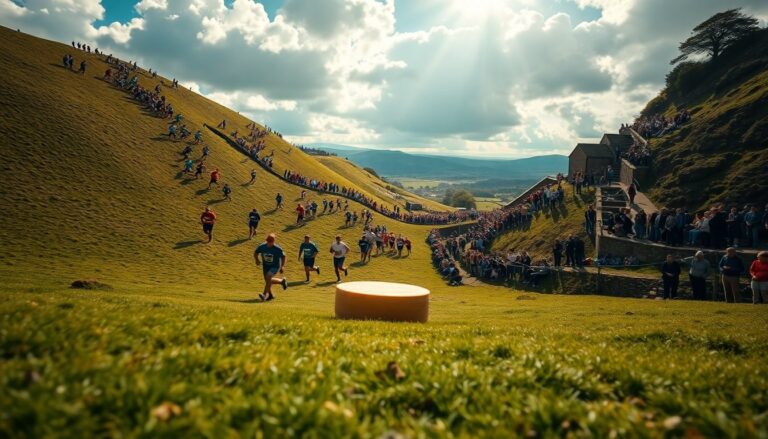
The steep slope of Cooper’s Hill in Brockworth hosted its traditional scramble as competitors hurled themselves after a rolling wheel of Double Gloucester. More than just a local spectacle, the event drew hundreds of daring participants and thousands of spectators to see whether the cheese could be caught or who might tumble to the bottom first.
Among the runners was Tom Kopke, a 24-year-old German YouTuber from Munich and a recent double champion, who narrowly finished ahead of local star Chris Anderson. The scene combined raw athleticism with a carnival atmosphere, as people cheered while racers sprinted, tripped, and somersaulted down a slope with a 1:2 gradient.
Conditions on the day made the chase unpredictable. Heavy spring rain had previously softened the turf, while a spell of heat had recently firmed the surface, creating a tricky mix for runners. Officials and onlookers noted temperatures that approached the high twenties Celsius, adding physical strain for both competitors and the crowd.
The rolling cheese can reach astonishing speeds — reporters and participants have cited figures up to 70mph — so the act of following it down the hill carries clear risk. Despite the danger of falls and possible broken bones, many contestants still travel considerable distances to take part, turning the event into a global curiosity.
The close contest and the comeback attempt
The headline race saw Tom Kopke holding on to the title he had won in previous years after a tense duel with Chris Anderson, the local competitor who holds a Guinness World Record for most wins. Anderson, who has claimed victory more than twenty times between 2005 and 2026, briefly returned from retirement to challenge Kopke, adding extra drama to the competition. The decisive finish was extremely tight: Kopke closed in rapidly on the final stretch and just managed to edge Anderson over the line. At the base of the hill a mutual embrace followed the announcement, underlining the sportsmanship that coexists with the chaos of the race.
The cheese behind the chase
Every winner leaves with a wheel of cheese produced by a long-standing local supplier. Rod Smart and his family run a small dairy in Churcham and have supplied the event for decades. Their hand-made Double Gloucester wheels — typically around 3.5kg each — are pressed under heavy weight and matured in controlled conditions for months. The Smart family continues a multi-generational craft begun by Diana Smart, who introduced traditional cheese-making to the household and ensured strict attention to process. Despite being hurled down a steep hillside, the wheels are robust enough to survive impacts and are prized by winners as much for tradition as for taste.
How the cheese is prepared
The production of each competition wheel involves physically demanding steps: curd processing, repeated pressing with weights that sum to almost 3/4 tonne, and an ageing period that can last several months. This regimen forces out whey and firms the texture, which is why the Double Gloucester used in the race is durable enough to endure being rolled at high speed. The Smarts supply multiple full-size wheels plus several smaller cheeses for children’s races and giveaway prizes, maintaining a link between artisan food production and an eccentric local past-time.
Origins, logistics and safety
The Cooper’s Hill chase is embedded in local lore and thought to have ancient origins tied to springtime gatherings. In modern times the event has oscillated between informal tradition and official concern: a surge of spectators in 2009 prompted cancellation of the sanctioned event in 2010, and since then enthusiasts have organised unofficial races while police monitor for safety. Organisers and authorities now coordinate road closures that can extend up to two and a half miles around the hill on busy years, and international media frequently cover the spectacle. The presence of visiting competitors and TV crews has helped transform the race from a village custom into an internationally recognised oddity.
Safety debate and tradition
The race raises recurring debates about health and safety versus cultural heritage. Past discussions have even led to the temporary use of a lightweight foam wheel before organisers reverted to the genuine cheese. Competitors accept the risk of tumbles and injuries as part of the challenge, while local authorities balance crowd control and emergency readiness. For participants like Kopke, the strategy often comes down to committing fully: competitors report relying on instinct and momentum rather than technical technique when hurtling down the slope.
In the end, the spectacle remains as much about community and continuity as it is about competition. The winner took home a wheel of Double Gloucester from the Smarts’ farm and described the prize as especially sweet after a hard-fought race. Whether observed as a daring sport, a quirky tradition, or an excuse for a bank holiday gathering, the Cooper’s Hill chase continues to draw attention and inspire stories each time a cheese is launched down the hill.