Explore the richly painted interior of the Mansfield Traquair Centre, often called Edinburgh’s Sistine Chapel, and learn about Phoebe Anna Traquair, the historic building and its restoration
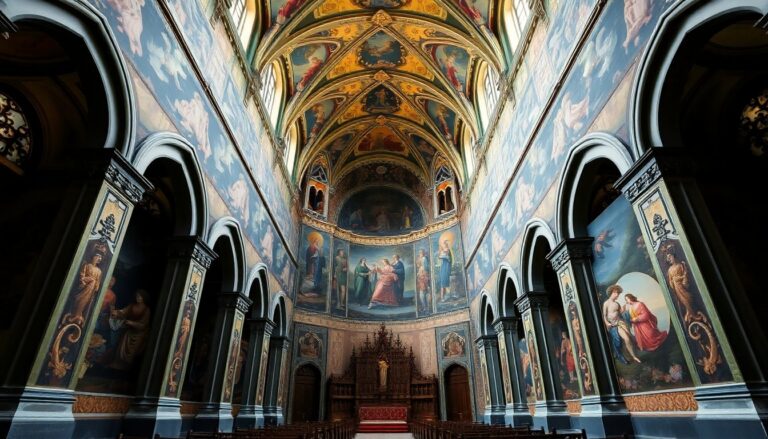
Phoebe Anna Traquair spent nearly a decade transforming the interior of the Mansfield Traquair Centre in Edinburgh’s New Town, painting a vast cycle of murals between 1892 and 1901. Housed in a restrained Victorian building by Sir Robert Rowand Anderson, the painted interior—often nicknamed “Edinburgh’s Sistine Chapel”—turns the nave and chancel into a continuous panorama of colour, imagery and richly textured decoration.
Later conservation work rescued the fragile scheme and reopened the space to the public, allowing visitors to experience Traquair’s unique fusion of narrative and ornamentation.
The building and its surprising interior
From the outside the Traquair building looks deliberately modest; it follows late-Victorian ecclesiastical lines and was completed in 1885 as a worship space for the Catholic Apostolic Church.
Inside, however, Traquair’s murals sweep across walls, arches and ceilings, turning the church into an immersive painted environment. She combined biblical scenes, allegory and medieval-inspired motifs with Arts and Crafts and Pre-Raphaelite influences, using paint, gilding and modelled plaster to introduce relief, texture and gleaming highlights that catch the light.
What Traquair painted
Traquair organised the decoration as a theatrical sequence. The south wall unfolds episodes from the Old Testament; the north wall moves through the New Testament and climaxes in the Ascension of Christ rather than a crucifixion scene. Around the chancel arch she placed symbolic motifs and apostolic personifications that articulate the congregation’s theological ideas. Smaller chapels contain barrel-vaulted parable scenes and medieval-style animal motifs—the latter a clever melding of natural history and sacred symbolism that gives the roofscape its own lively character. Figures climb and curve across vaults and ceilings in dynamic poses, so that the whole interior reads as a continuous visual story.
Technique and challenges
Traquair’s methods were ambitious. She worked on site for nearly ten years, layering paint over modelled plaster, applying gilding and adding low relief to enhance depth and luminosity. Those same techniques that make the murals so striking also make them delicate and demanding to conserve: gilding and relief require specialist care, and the multi-layered surfaces are vulnerable to damp, dirt and mechanical wear.
Decay, rescue and restoration
Through the twentieth century cycles of neglect and changing ownership left large areas of plaster unstable and vulnerable to moisture. After decades of partial disuse, the Mansfield Traquair Trust took stewardship of the building in 1998. Thanks in part to a Heritage Lottery Fund grant awarded in 1996 and further support, a major restoration began in 2003. Conservators consolidated failing plaster, removed grime, stabilised pigments and, where losses were irretrievable, carefully reintegrated small areas of imagery in a way that remains distinguishable from Traquair’s original hand. Varnishes and protective finishes were reapplied with sensitivity to recover colour without obscuring the artist’s intent.
Access and ongoing care
The restoration made it possible to reopen the interior for supervised public visits and events. Today the building functions as a cultural venue—hosting weddings, conferences and open days—while the trust balances public use with conservation needs. Controlled access, regular condition monitoring and specialist conservator oversight form the backbone of the site’s stewardship strategy. Ongoing environmental management and scheduled maintenance remain essential to preserving Traquair’s fragile surfaces for future generations.
Why it matters
Traquair’s murals are not only a remarkable feat of Victorian decorative painting; they offer a rare, cohesive vision that marries scripture, medieval reference and natural imagery in a single, continuous interior. The restoration returned much of that vibrancy and secured the building’s future as both an artistic treasure and a living venue. Visitors today can still encounter the powerful blend of narrative, colour and craft that makes Mansfield Traquair an unforgettable piece of Edinburgh’s cultural landscape.