A powerful earthquake with a magnitude of 7.8 struck the southern Philippines, causing widespread destruction and claiming at least 37 lives. Rescue efforts are underway as authorities assess the damage.
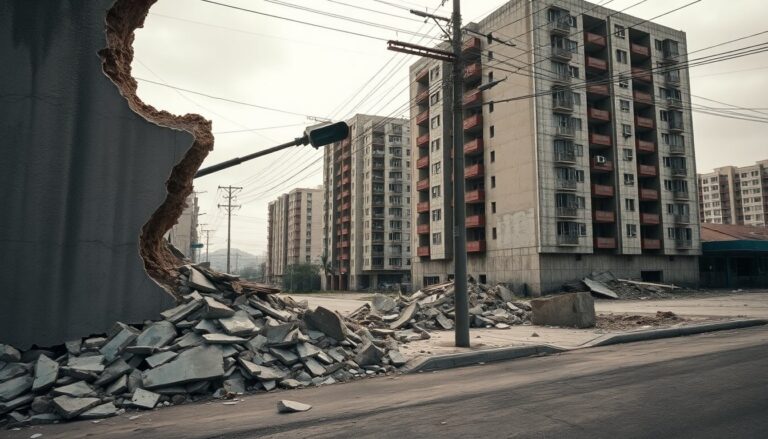
The southern Philippines was struck by one of the most powerful earthquakes in decades, leaving a trail of destruction and claiming at least 37 lives. The magnitude 7.8 quake, which hit early on Monday, has displaced more than 32,000 people and caused significant damage to infrastructure across several provinces.
The earthquake’s epicenter was located off the coast of Mindanao, the country’s second-most populous island. The quake triggered tsunami warnings and caused panic among residents, many of whom fled their homes fearing a tsunami. While waves up to 1.4 meters above tide level were measured, the only reported tsunami damage was to six stilted shanties in a coastal village.
The impact on General Santos and surrounding provinces
The city of General Santos, known as the country’s tuna capital, was particularly hard hit. At least 13 people died from collapsing buildings and falling debris. In Sarangani province, 18 fatalities were reported, primarily due to a landslide that engulfed houses in the mountainous town of Glan.
Additional deaths were confirmed in South Cotabato, Davao Occidental, and Balut Island.
Initial government assessments indicated that around 2,500 houses and 117 government buildings and facilities were damaged across several provinces. The General Santos airport was closed for the second day, leading to the cancellation of at least 63 domestic flights. Authorities have also reported that nearly 6,000 public school buildings in the affected provinces need to be evaluated before classes can resume.
Aftershocks and ongoing rescue efforts
Rescue crews continued searching ruined buildings across the affected areas, acknowledging that several collapsed and damaged structures required thorough inspections for potential survivors or further casualties. Authorities have issued warnings that buildings with cracks could collapse due to aftershocks, some of which have been dangerously powerful.
“We cannot force the immediate reopening of schools because we have to ensure the integrity of the buildings,” stated Rafaelito Alejandro from the Office of Civil Defence. The earthquake struck on the first day of school after a two-month summer break, and many of the injured were young students attending morning flag-raising ceremonies.
Historical context and international support
The earthquake was centered at sea around 32 kilometers southwest of Maasim town in Sarangani province. It was triggered by movement in the Cotabato Trench and marked the strongest seismic event since the same undersea depression caused an 8.1-magnitude quake that generated tsunami waves on 17 August 1976. Teresito Bacolcol, director of the Philippine Institute of Volcanology and Seismology, noted that nearly 8,000 people were killed by that earlier quake and its subsequent tsunami waves.
President Ferdinand Marcos Jr has sent senior defence and mitigation officials from Manila to oversee search and rescue operations, coordinate the distribution of food and construction materials to victims, and assess damage to vital infrastructure such as bridges and roads. The US, a treaty ally of the Philippines, has expressed readiness to help with the response, along with Malaysia, France, Japan, and New Zealand.
The Philippines is frequently affected by earthquakes and volcanic eruptions due to its location on the Pacific “Ring of Fire,” an arc of seismic faults encircling the ocean. The archipelago is also battered by 20 typhoons and tropical storms annually, making it one of the most disaster-prone countries in the world.